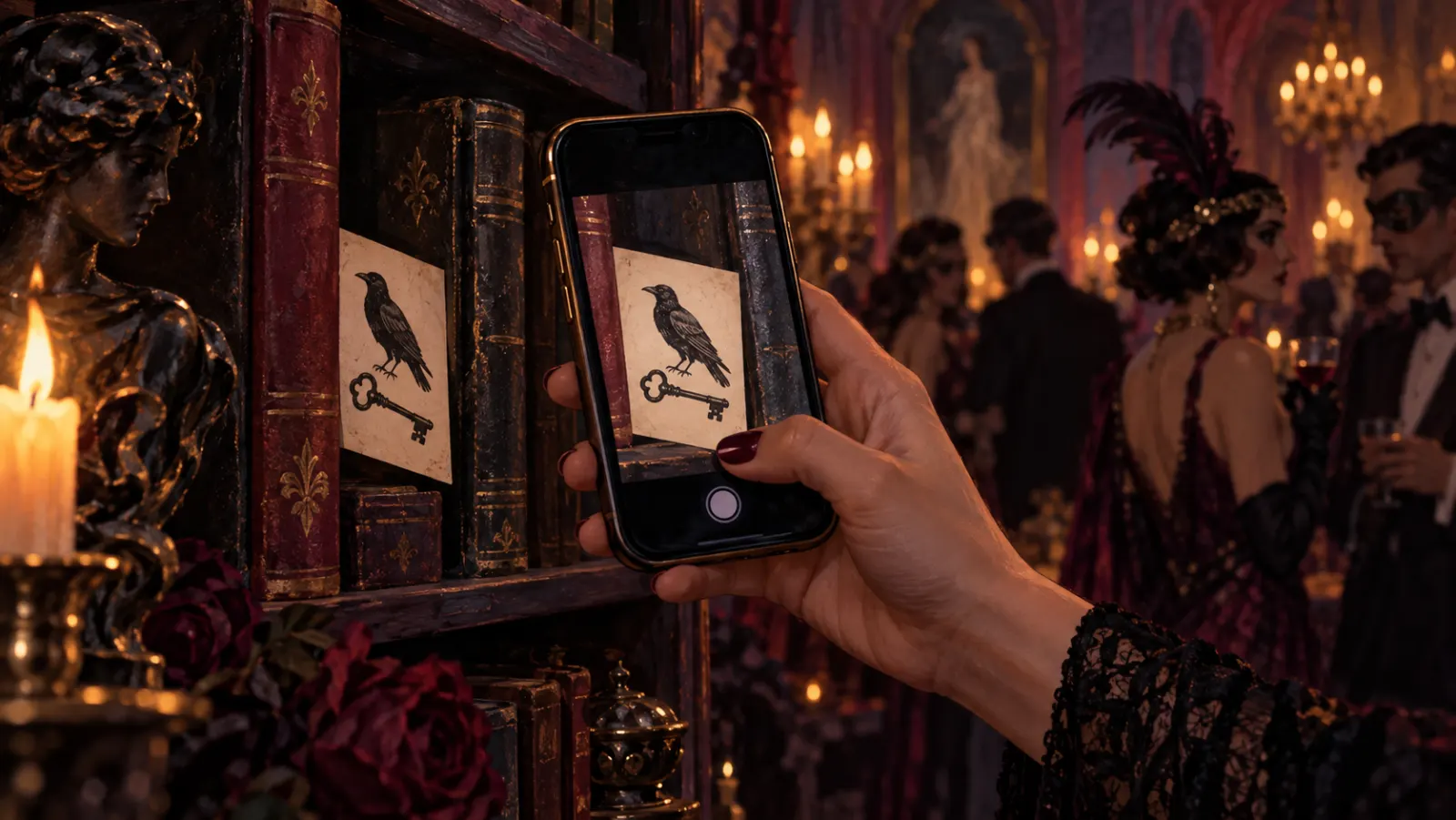
QR codes turn an ordinary scavenger hunt into something that feels high-tech, with almost no extra effort. Everyone already has a scanner in their pocket: the phone camera. Here are ideas, practical tips and a few pitfalls to avoid.
How a QR scavenger hunt works
You print QR codes, hide them, and each code reveals something when scanned: a clue, a riddle, a photo, a points value or a piece of a story. The code can link to a web page, a document, a video or a game.
Theme ideas
- Murder mystery. Each code reveals evidence that clears a suspect, room or weapon until only the culprit remains. (This is exactly what InQuestion automates.)
- Treasure map. Each code reveals the next location as a riddle.
- Time travel. Codes hidden in different "eras" around the house reveal historical facts.
- Escape room. Codes reveal digits of a padlock combination.
- Book hunt for libraries: codes hidden in books reveal quotes; players guess the title.
- Office onboarding. Codes around the office introduce teams, people and facilities.
Hiding spots that work
- Inside a cupboard door or the fridge door
- Behind a picture frame, poking out slightly
- Taped under a table edge
- Between books on a shelf
- On the back of a chair
- Under a plant pot (put it in a plastic sleeve)
- On a lampshade (away from the bulb)
- On a window, facing in, readable from the inside
Printing tips
- Size: at least 3 cm (just over an inch) square; 5 cm is better for dim rooms.
- Contrast: black on white, never on coloured paper. Phones struggle with low contrast.
- Quiet zone: leave a white margin around each code or it may not scan.
- Lamination: worth it outdoors or in kitchens. A plastic sleeve works too.
- Numbering: print a number next to each code so you can find and collect them afterwards.
Stopping players from cheating
QR hunts have one big weakness: people photograph a code and share it. Some fixes:
- Make codes reveal different things to different players, so sharing doesn't help.
- Add a cooldown between scans so racing to every code is pointless.
- Give points for being first to scan.
- Use a game that records who scanned what, so a code only counts when it's scanned in person.
InQuestion handles this by tying each scan to the player's own phone and giving each scan a short cooldown, so the fun is in moving around, not in sharing screenshots.
Puzzle chain ideas
Simple "scan and read" hunts are great for young kids. For older players, chain the codes into puzzles:
- Riddle chains. Each code reveals a riddle whose answer is the next hiding place.
- Letter collection. Each code reveals one letter; players unscramble the final word.
- Elimination. Each code rules something out until one answer remains. This is how a murder mystery works, and it's satisfying because every scan matters.
- Map pieces. Each code reveals a fragment of a map; the complete map leads to a prize.
Troubleshooting scans
- The camera won't focus. Print the code bigger or move it into better light.
- Nothing happens on iPhone. Make sure the code isn't laminated with a glossy finish that reflects ceiling lights; tilt it slightly.
- Older Android phones. Some need Google Lens or a scanner built into the camera's "more" menu. Test with the oldest phone you expect at the party.
- No signal in the basement. Share the Wi-Fi password on the start poster, or keep codes out of dead zones.
Making it replayable
The downside of a homemade QR hunt is that once people know what's behind each code, it's done. A smarter approach is to print the codes once and change what they mean every time. That's how InQuestion's evidence kit works: the same printed placards hold different clues every game, so a rematch is a new mystery.
For classrooms and libraries
QR hunts are great for getting students moving and reading. Keep codes at child height, pair students up so every pair needs only one device, and make the reveal content short and readable. A mild, cozy mystery theme works brilliantly for ages 10 and up; see our teens and families guide.
How many codes do you need?
- Kids' party (5–10 players): 10–15 codes in two or three rooms.
- Adult party (6–20 players): 20–30 codes across the house.
- Large event (20–40 players): about 30 codes, plus a short cooldown between scans so people spread out rather than racing.
More codes isn't always better. Every code should be findable in under five minutes of searching, or players lose interest.
Quick-start checklist
- Pick a theme and decide what each code reveals.
- Print codes large, high-contrast and numbered.
- Hide them across the space at varied heights.
- Test-scan every code in its hiding spot, in that room's lighting.
- Put a "start here" code by the entrance.
- Collect codes afterwards using the numbers.
Want the murder mystery version without building it yourself? Host an InQuestion game free and print a ready-made evidence kit.