We make a phone-based murder mystery game, so take this with the appropriate pinch of salt. But we've played plenty of every format, and each one is great for different groups. Here's an honest look at the trade-offs.
The four main formats
Boxed or printable role-play kits
You buy a kit (physical or PDF) with a character booklet for each guest. Over several rounds, players read lines, reveal secrets and question each other. At the end, everyone guesses and the solution is read out.
Strengths: rich characters and dialogue; great for theatre lovers; works with no technology at all.
Weaknesses: needs a fixed player count; shy guests can find it stressful; the host often has to run it; once you know the ending, you can't replay it with the same group.
Best for: dinner parties of 6–12 friends who enjoy acting.
Host-run clue games
One person is the game master, managing envelopes of clues, timing reveals and answering questions.
Strengths: completely flexible; can be adapted to any group.
Weaknesses: the host works all night and doesn't really play; hard to scale past about 15 people.
Best for: a host who loves running games more than playing them.
Hired actors
A company sends actors who perform the mystery around your guests.
Strengths: spectacular; zero prep.
Weaknesses: expensive; needs booking well ahead.
Best for: corporate events and weddings with a budget.
Phone and app murder mysteries
Clues are hidden physically or virtually and discovered on players' phones. The game tracks what each player knows and handles the rules and reveal.
Strengths: little prep; scales to large groups; the host can play; often replayable because the solution changes.
Weaknesses: needs phones and decent signal; less scripted dialogue and character acting than a booklet kit; some groups prefer a screen-free night.
Best for: mixed groups, big parties, offices and anyone who wants to play rather than run the game.
Comparison at a glance
- Prep time: printable kits 1–3 hours (printing, sorting envelopes); host-run games 2+ hours; actors almost none; phone games 10–30 minutes.
- Group size: printable kits usually 6–12; host-run up to about 15; actors any; phone games 3–40 or more depending on the game.
- Replayability: printable kits once per group; host-run varies; actors once; phone games often many times if the solution is randomised.
- Host plays too? Printable kits sometimes; host-run no; actors yes; phone games usually yes.
Cost per person
Prices vary a lot, but as a rough guide:
- Printable PDF kits often cost about the same as a takeaway meal for the whole group, plus printing.
- Boxed kits cost more but come with props and nice materials.
- Hired actors are usually priced per event and can run to hundreds or thousands.
- Phone games range from free to a small one-off fee per game.
For large groups, cost per person matters: a single fee shared across 30 people is pennies each, while per-character kits can't stretch to 30 at all.
Questions to ask before you buy any kit
- How many players does it really support, and what happens if someone cancels?
- Does someone have to run it, and can they still play?
- Can we play it again, with the same group, without knowing the answer?
- How long does setup take, including printing?
- Is the content right for my guests: tone, themes and reading level?
- What do guests need: phones, costumes, scripts?
What about InQuestion specifically?
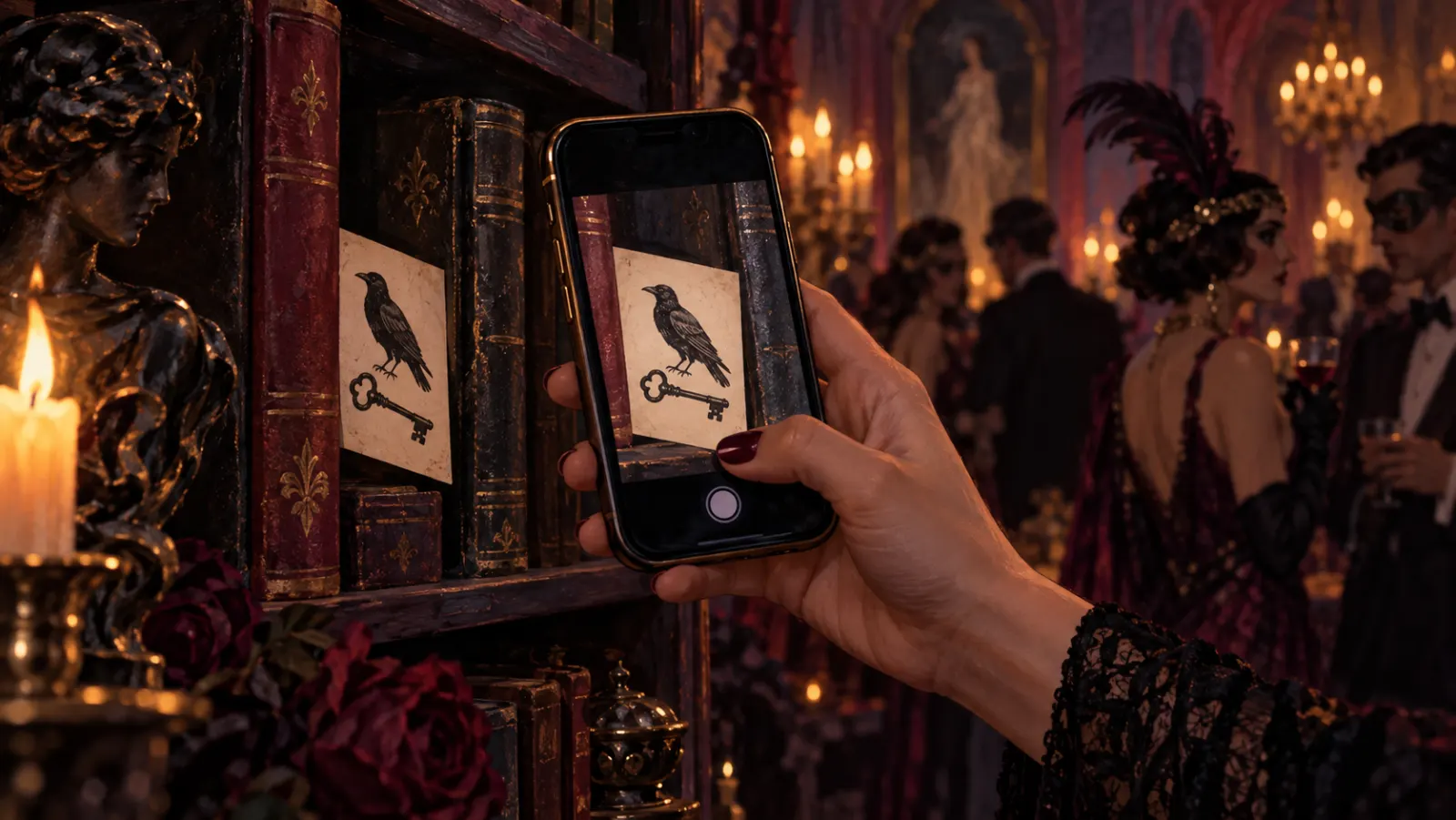
InQuestion is a phone game with a physical twist: you print a kit of QR "evidence" placards once and hide them around your space. Guests scan them with their normal camera, with no app download. The killer, room and weapon are random every game, so the same kit gives endless rematches. Story twists, phone-minigame interrogations and the finale run automatically.
It's weaker where booklet kits are strongest: there's no scripted dialogue for each character. Instead, each guest gets a suspect with a costume idea and a catchphrase, and the role-play is as big or small as your group wants.
A note on screens
Some hosts worry that a phone game means everyone staring at screens all night. In practice, discovery-based games are the opposite: phones come out for a few seconds per clue, and the rest of the time people are walking, searching and arguing. Scripted kits are more screen-free but more seated. If a screen-free night is important to you, choose a booklet kit; if movement and mingling matter more, a phone game is the more active option.
How to choose
Ask three questions:
- Do my guests want to act? If yes, a booklet kit will delight them. If not, choose a discovery-based game.
- How many people are coming? Past 12, choose a format where people act in parallel.
- Do I want to play? If you'd rather not run the night, choose actors or a self-running game.
There's no wrong answer; any murder mystery beats another night of small talk. If a self-running game sounds right, InQuestion is free for up to 6 players.